To help us visualize the size of the wolf, let's look at the comparison of a wolf and an Alaskan malamute, both weighing 100 pounds: The wolf''s head was longer, wider and generally larger, while the malamute was bigger in the chest by a few inches. Although they both had 42 teeth, the jaw pressure of the wolf was double that of the malamute. The wolf stood two inches taller, was three inches longer in the leg, and eight inches longer in the body. The wolf's track was twice the size of the dog.
The average weight for a North American wolf is 80 pounds, although it is not uncommon to see a wolf in Alaska, weighing over 100 pounds. Males are generally five to ten pounds heavier than females. Many Alaskan's say the largest wolves are black.
L. David Mech
 The wolf's most indispensable personality trait is the ability to exist as part of a group, to form an attachment to others of it's kind. Wolves are social animals of the first order. The presence of an understood hierarchy serves the crutial purpose of elimating conflict. This usually consists of a pack of five to ten wolves. The pack has a defined social structure, one that enhances their survival by collective hunting and population control. This hierarchy is subject to change, especially during breeding season.
 In extreme cold the wolf can reduce the flow of blood near it's skin to conserve heat. When in contact with ice or snow, the temperature of the wolf's footpads remain at just above the tissue freezing point. The wolf's ability to regulate it's body temperature has helped it to survive in a wide variety of climates.
The wolf's front feet are much larger and a great advantage when running upon snow. It allows greater weight distribution and more support to prevent the wolf from sinking in as deeply, when the snow is soft.

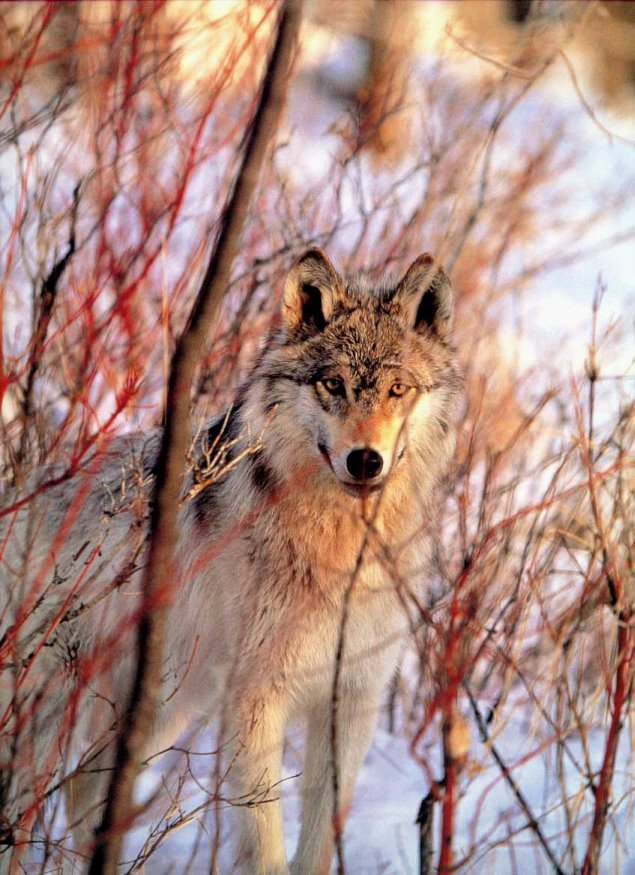
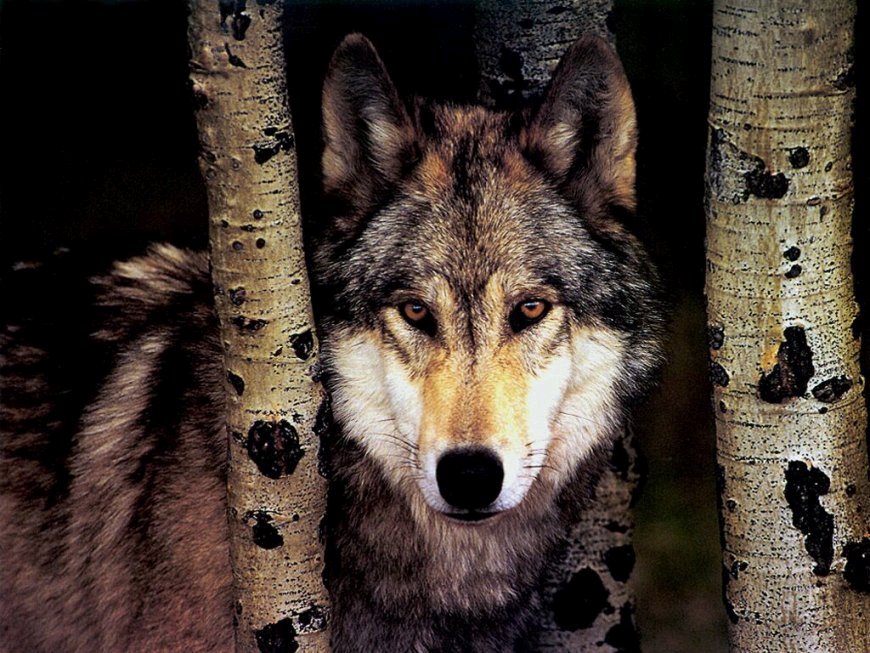
A wolf's coat can vary from white to various shades of beige, brown, gray and black. It consists of two layers; a soft light colored, dense fur, covered by long guard hairs, which keep the undercoat dry. The shading of the fur, which is more distinctive around the face, accents the wolf's facial communication. In the late spring the wolf sheds his winter coat. The new hair that forms the short summer coat, continues to grow just enough to gradually form the long winter coat.
In "Of Wolves And Men", Barry Lopez writes how Nunamiut hunters in Alaska are keen observers of detail and are able to tell a wolf's age and sex, from a distance, by the color and condition of it's pelage. They can also tell from a wolf's track if it is rabid, as it has a tension in the muscles of his feet that keep his footpads spread, when he is walking on dry ground.
L. David Mech
 Wolves in warmer climates have shorter guard hairs and less dense undercoat. The red wolf, which lives in hot, humid areas, has a shorter coat and longer pointed ears, than the wolves of the north. Short ears are less sensitive to the cold, while long ears are efficient dissipaters of body heat.

Wolves breed once yearly, in February or March and four to six pups are born, sixty three days later. Usually, only the alpha pair breeds, although the entire pack assists in the raising of the pups. When a pup becomes sexually mature at two years, he may stay with the pack or start one of his own. When a wolf curls up at night, it uses it's bushy tail to cover it's feet and nose. The tail placed over the nose holds the warm air exhaled from the lungs over the feet and nose, warming them.
Social relationships are maintained by vocalization, and postural and facial expressions. Due to an understood dominance hiarchy, pack members rarely injure one another. Fatal encounters with other wolf packs are avoided by the use of territories with overlapping boundries, which are held by scent marking and howling.